Atlas and Malarkey, and what a shingle spec means
Keys installs Atlas and Malarkey. Not a third brand, not whatever is cheapest that week. Here is what the numbers on a shingle wrapper do and do not tell you.
- Sheet
- A10
- Subject
- Shingle products and specification
- For
- A homeowner choosing material
- Trade
- Roof replacement
Two lines, and why a short list is a good sign
A roofing company that will install any brand you name is not offering you choice, it is telling you it buys whatever the supply house has. Working from a short list means the crew knows the product: how it lays in cold weather, how it cuts, where the nail line is, how the caps behave on a hip, how the colours actually look at roof scale rather than on a sample board. That familiarity is worth more on the finished roof than any comparison chart.
Both Atlas and Malarkey are laminated architectural shingles rather than the old flat three tab. Laminated means two layers bonded together, which gives the shingle its shadow line and its thickness, and makes it heavier and more resistant to wind lift than a single layer tab. The visible difference from the street is that an architectural roof has depth and a three tab roof looks painted on.
What is deliberately absent
This page publishes no certification tier, no warranty term in years, no star rating and no claim that either line beats the other. Those belong to the manufacturers and to Keys Roofing's own published material, and inventing one to fill a gap on a website is where roofing marketing goes wrong.
What a wind rating actually is
The wind figure on a shingle wrapper is the result of a laboratory test performed on a shingle installed exactly as the manufacturer specifies, on a sound deck, with the specified number of fasteners driven in the specified line, and with the sealant strip properly sealed. Change any one of those on your roof and the number on the wrapper is describing a different roof than yours.
- Nail count and placement. Fasteners have to land in the nailing zone. High nailing, which is faster, misses the top of the shingle below and leaves the course held by half of what the test assumed.
- Overdriven or underdriven nails. A nail driven through the mat, or left standing proud, is not a fastener. This is a compressor pressure and an attention problem and it is invisible once the next course is down.
- Sealing. The adhesive strip needs warmth to bond. A roof laid in genuinely cold weather may not seal until the following spring, which is normal and is a reason to be careful about what is promised for a January roof rather than a reason not to do one.
- The edges. Wind gets under a roof at the rakes and the eaves. That is what a proper starter course is for, and it is why sheet A07 spends time on a component nobody ever sees.
Ask a bidder what nailing pattern they use on the product they are quoting and how many fasteners per shingle. It is a simple factual question with a published correct answer, and the response tells you whether the person in front of you has read the installation instructions for the product they are selling.
Colour, at roof scale
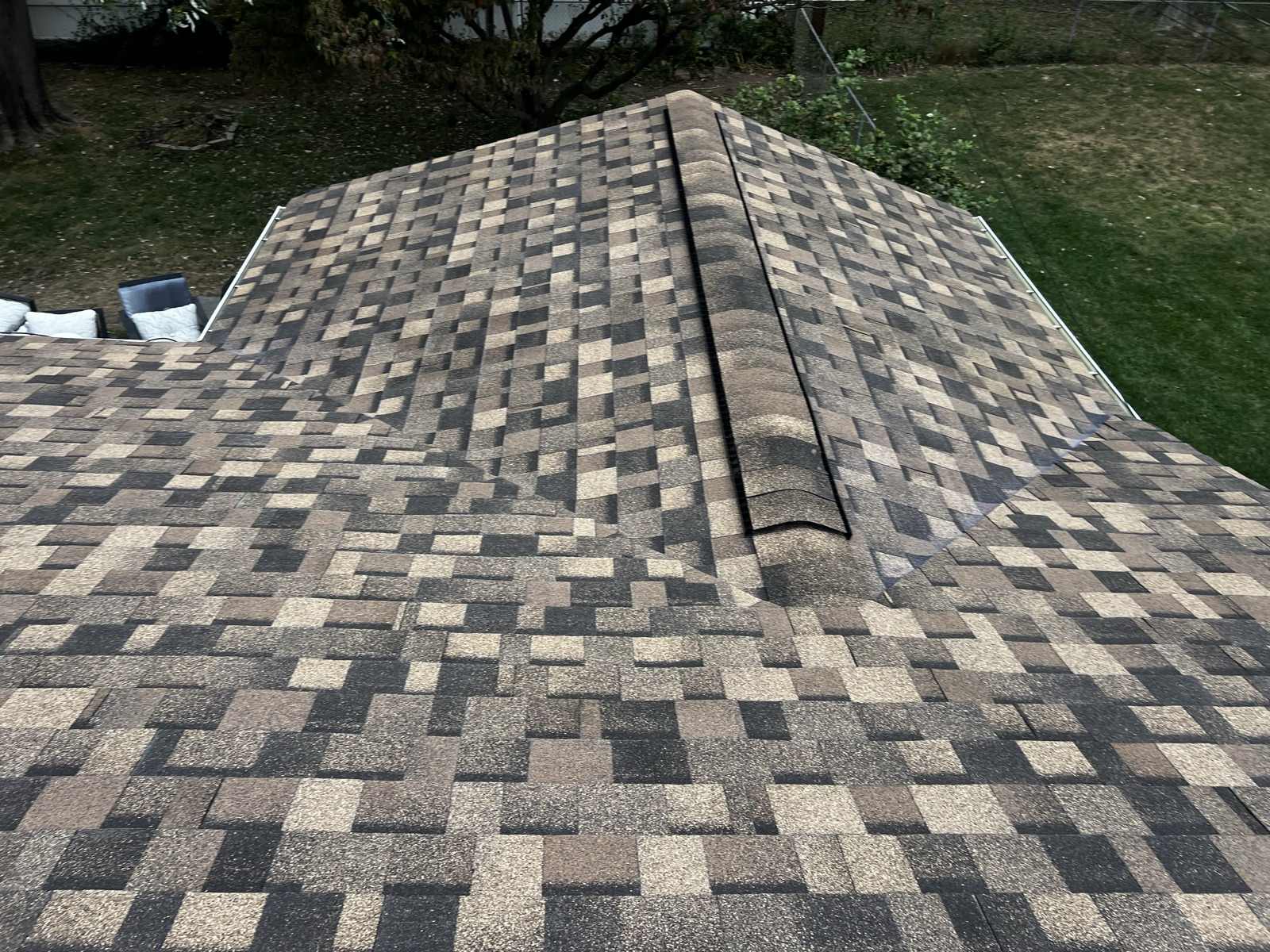
Colour is the part homeowners agonise over and the part that is hardest to judge from a sample. A four inch swatch of a multi tone blend looks like a pattern. The same blend across a large plane reads as a single field colour with texture in it, and the individual tones disappear at any distance. The plate on this sheet is a brown and tan blend photographed at roof scale, and it is worth comparing that to what a sample board of the same product looks like in your hand.
Two practical points. Dark colours look darker and heavier on a large simple plane than they do on a cut up roof, where shadow lines break the field up. And on a house with brick on the street elevation, the shingle is being asked to sit against a fixed colour you cannot change, so the sample belongs outside against the brick in daylight, not on a kitchen table.
Hip and ridge cap is a separate product from field shingle. Cap made by folding cut field shingle over a ridge is a shortcut: it cracks at the fold on a cold day and it does not sit down the same way. If the ridge and hips on your house are prominent, and on the hip roofs common in this town they usually are, ask what is going on them.