What is under the shingles
Everything below the surface is invisible the moment the roof is finished, which makes it exactly where a bid gets quietly cheaper without looking cheaper.
- Sheet
- A07
- Subject
- Decking, membrane, underlayment
- For
- A homeowner reading a scope
- Trade
- Roof replacement
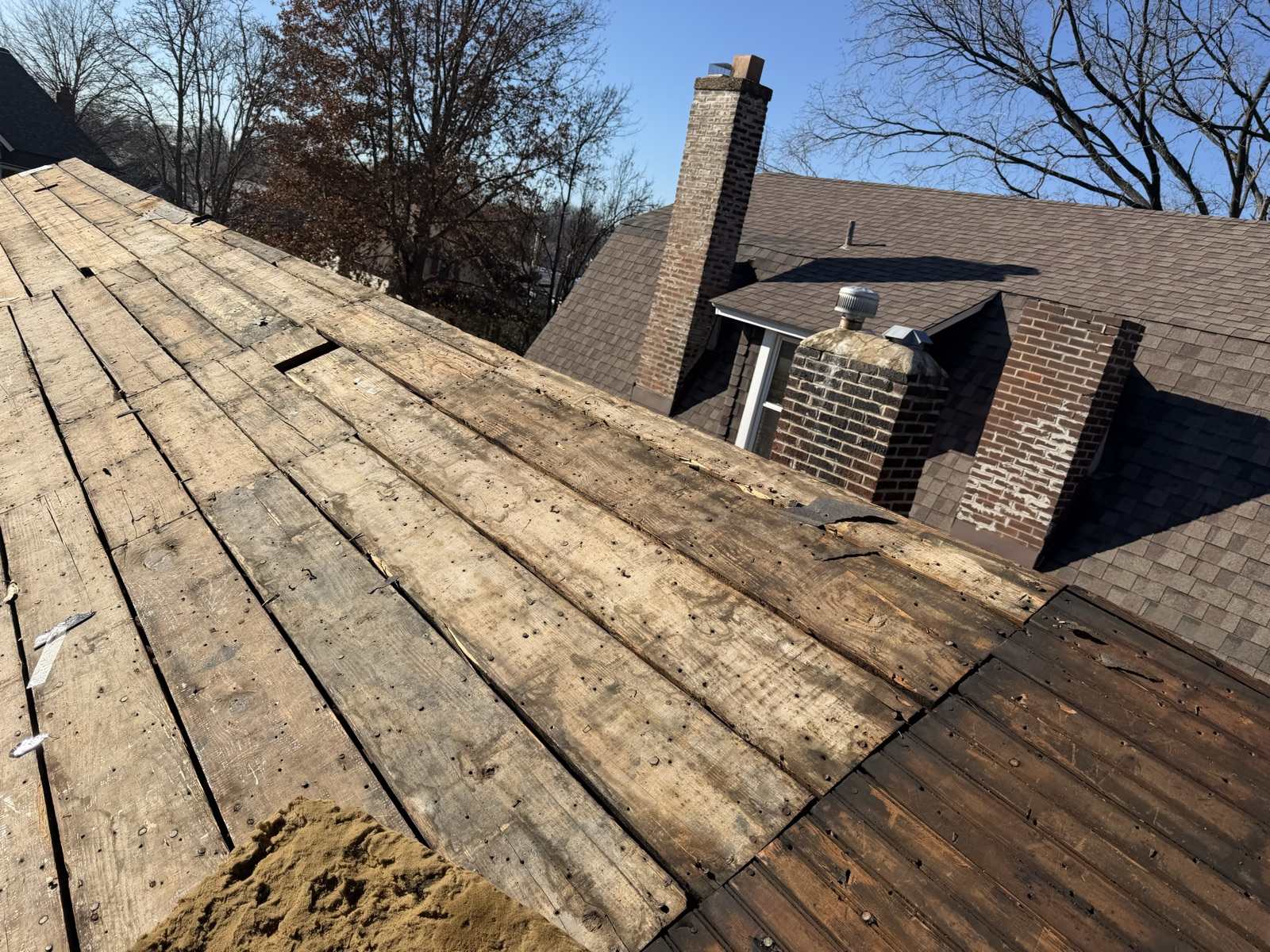
The deck
Under the shingle is the deck, and in this metro it is one of three things. Older houses, particularly anything built before the mid century, are commonly on wide wooden planks laid with gaps between them. Houses from the sixties and seventies are usually on plywood. Newer construction is almost always on oriented strand board. Each of them behaves differently and each of them fails differently.
Plank decking holds a nail well when it is sound, but the gaps between boards mean that a nail which lands in a gap is holding nothing at all, and the boards split along the grain after enough tear offs. Plywood delaminates when it has been wet. Oriented strand board swells at the edges when it gets wet and, once swollen, never really goes back. All three get progressively worse at holding fasteners each time a roof is torn off and re-nailed into the same wood.
The permit interaction
Replacing more than a quarter of the decking is one of the St. Louis County thresholds that puts a job into permit territory. On a roof that turns out to be badly deteriorated, that boundary can be crossed partway through the day, which is a reason to have the conversation before the strip rather than during it. See sheet A05.
The layers, in order off the deck
- Drip edgeMetal at the eaves and up the rakes. It keeps water from curling back under the edge of the deck and rotting the fascia, and it gives the starter course something solid to sit against. It is cheap, it is required by good practice, and it is left off surprisingly often.
- Ice and water barrierA self adhering membrane that seals around the fasteners driven through it. It belongs at the eaves, where ice dams back water uphill, and in every valley, where water concentrates, and around every penetration. How far up from the eave it runs is a real specification and a real cost, and it is worth having on the paper.
- UnderlaymentAcross everything else. Synthetic underlayment has largely replaced felt on residential work because it is tougher underfoot, does not tear as readily in wind and does not wrinkle when it gets damp. Felt is not a scandal, but if two bids differ and one is on synthetic, that is part of why.
- Starter courseA purpose made starter strip at the eaves and up the rakes, with its adhesive in the right place to seal the first course down. Cutting up field shingle to fake a starter puts the sealant strip in the wrong position and leaves the edge of the roof, which is the edge the wind gets under, relying on nothing.
- FieldThen the shingles, to the manufacturer's nailing pattern, which is the specification that determines whether the wind rating on the wrapper means anything at all. See sheet A10.
Three phrases that should slow you down
This is not a specification, it is an absence of one. What was there may have been wrong. Ask what is going down, by name and by location, and have it written on the scope.
Nobody can assess a deck through a shingle roof. It is a statement about the shingle. The deck is assessed when it is bare and not before, and the honest version of that sentence is that a unit price is agreed in advance for whatever is found.
Valleys concentrate the water from two planes into one line and hold debris. In a metro that freezes and thaws repeatedly through the winter, a valley without a membrane under it is a calculated risk taken with somebody else's ceiling.