What the day of the work actually looks like
A tear off is loud, fast, filthy and over quickly. Almost everything that goes wrong on the day is something nobody discussed the week before, so here is the week before.
- Sheet
- A06
- Subject
- Day of work, preparation and completion
- For
- A homeowner with a date booked
- Trade
- Roof replacement
Before the truck arrives
- Move the cars outThe driveway is a work surface and a debris zone. Park on the street the night before, not at seven in the morning while a crew waits.
- Clear the perimeterPots, furniture, grills, hoses, garden ornaments, anything on a deck under a roof edge. Crews tarp, but a tarp does not stop a bundle of shingle.
- Think about the atticA tear off transmits real vibration through the structure. Anything stored on open joists, and anything hanging on a wall directly under the roof, is worth taking down for a day. Dust will come through the deck gaps of an older plank roof no matter what anybody does.
- Settle the extras in writingA satellite dish, a solar array, an antenna, a security camera on the fascia. Removing and refitting any of those is a separate scope and sometimes a separate trade. Decide who is doing it, and write it down, before the day rather than on it.
- Plan for the dogNail guns, compressors and shingle hitting a dumpster all morning. Most dogs have a bad day. Arrange somewhere else for them if you can.
The dumpster question
Ask where it is going before the day. A loaded roofing dumpster is very heavy and a decorative driveway apron or a newly sealed drive can crack under one. Plywood under the wheels is normal practice and worth asking for.
The shape of the day
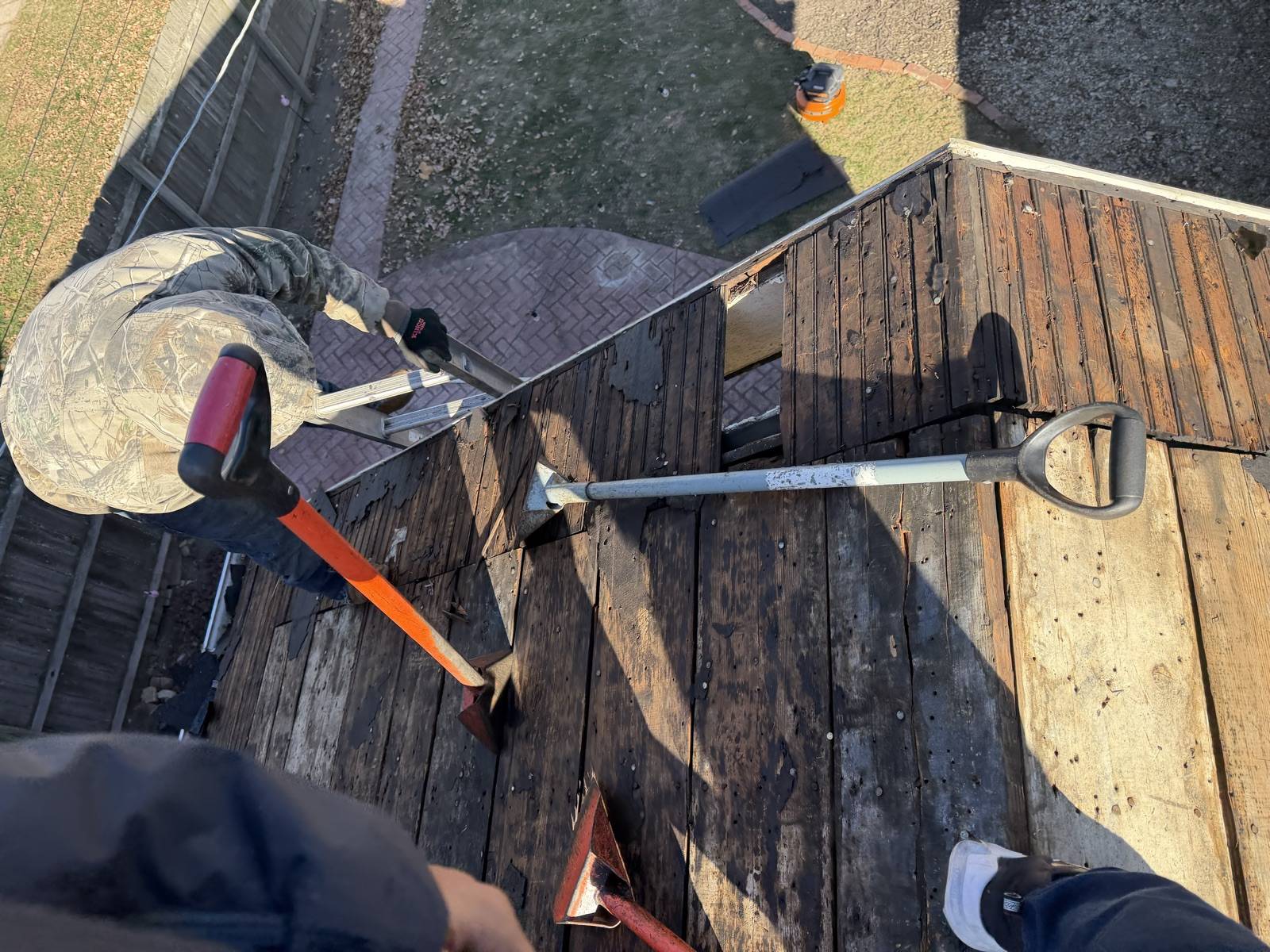
Crews start early, and in a Missouri summer they start very early, because a roof surface becomes genuinely dangerous by mid afternoon in July. The strip is the loud part and it is usually the first two to four hours. Tear off bars and roofing shovels come up the ladder, tarps go down, and the old roof comes off in sheets into a dumpster or a trailer. It sounds far worse inside the house than it is, and it is the part where dust comes through an older plank deck.
Once a plane is stripped, that plane gets inspected, repaired where the boards are bad, and then dried in with edge metal, ice and water barrier and underlayment before anybody breaks for lunch. That sequence matters: a competent crew never leaves a stripped plane open longer than it has to be, and never leaves one open overnight if weather is anywhere in the forecast. If you are watching from the garden and a plane sits bare for hours, that is a fair question to ask.
The afternoon is field, then details, then cap. Details take disproportionately long relative to how little of the roof they cover, which is the visible sign of the point made on sheet A02: the transitions are the job. A simple roof finishes in a day. A cut up roof with several dormers and a lot of valley runs into a second.
What finished should mean
- The magnet has been over everything. Drive, walks, lawn, beds. Then again. And you have been told plainly that a nail may still turn up, because that is the truth.
- The gutters are clear. A tear off puts a startling volume of old granule into gutters. Leaving it there is how a brand new roof gets blamed for an overflowing gutter in the first big rain.
- The debris is gone the same day. Not the following week. Not "when the truck is back this way".
- Somebody walks it with you. Ground level, all four elevations, with photographs of anything you cannot see from down there.
- You have photographs of what was under it. The decking, the flashing that came off, anything that was replaced. If a roof was opened up and nobody photographed the inside of it, that information is gone forever.
The real test of a roof is not the walkthrough, it is the first driving rain with wind behind it, which in this metro will not be a long wait. Look at the ceilings under the valleys and around any chimney or sidewall, and look in the attic with a torch if you can get up there. If something is wrong, that is when it will say so, and a contractor worth the money wants that call.